

History of Wittenoom

Time Immemorial
For countless millennia, Banjima have lived on Country, maintaining spiritual and cultural connections to their Country through songlines, traditional law/lore, ceremonies, and custodianship. The concept of YURLU embodies the link between land, ancestors, and identity.

1930
The Merryweather and Price report establishes that asbestosis was a disease consequent upon exposure to asbestos. It described asbestosis in some detail as a horrific disease. 1

1937-1938
In 1937-1938 high prices for asbestos attracted prospectors to the Hamersley Ranges. Small amounts of milled asbestos fibre were produced by Western Australian Blue Asbestos Fibres Ltd and Messrs L G Hancock and P Wright in Yampire and Wittenoom Gorges. The Yampire Mine produced about 300 tons of asbestos fibre before it closed in 1946.3

1943
Hancock and Wright's interests were taken over in 1943 by Australian Blue Asbestos Ltd. (ABA). 4 The split is 49% Hancock and Wright, 51% CSR. Lang Hancock stays on as Assistant Mine Manager.

1948
CSR Ltd. acquires the (Yampire Mine) project as the parent company of Australian Blue Asbestos, taking over Hancock and Wright’s shares.5

1947- 1950
Wittenoom was officially gazetted as a town to support the growing asbestos mine. The town was developed to accommodate workers and their families, with infrastructure such as housing, schools, and basic services established to sustain the mining community. By 1951, Wittenoom had 50 houses and a population of over 500. 6

1959
Investigation by the Public Health Department of WA into the occurrence of silicosis and asbestosis in miners employed at Wittenoom. 10
Annual Report of the Public Health Department expresses concern about number of Wittenoom men affected by asbestosis and their relatively young age, and the extremely short dust exposures. 11

1960
Dr J McNulty of the Public Health Department diagnosed the first mesothelioma case arising from Wittenoom. The patient had worked at the mine for two years in the late 1940s. (Published 1962).12

1964
Request made by the Public Health Department for an expert from NSW (Gersh Major) to measure and report on the dust concentrations in the mine and mill.14

1966
In December, Sir James Vernon the Chairman of CSR announces the closure of asbestos mining operations at Wittenoom for economic reasons. He said, the mine had produced 131,000 tons of crocidolite of which over 100,000 tons of crocidolite were exported. 15 By then, over three million tonnes of deadly asbestos tailings were dumped across 46, 840 hectares of Banjima Country. This devastating process obliterated sacred sites and ancestral songlines. Tragically, local people were unknowingly exposed to lethal fibres without any protective measures.

1978
Government announces the closure of Wittenoom based on "The Health Hazard at Wittenoom" containing the results of air sampling and an appraisal of world-wide medical information.16
Subsequently, the Wittenoom Trust was established by CSR to provide financial assistance to former employees affected by asbestos-related diseases.17

1992
WA Parliamentary “Inquiry into asbestos issues at Wittenoom" led by Mark Nevill and Alan Rogers is published. Recommends that the tailings at the mine site should be cleaned up over a five to ten year period.25
These recommendations of the Nevill Report were rejected by Cabinet.

1994
Larry Graham Report of the Select Committee into Wittenoom
Chairman’s foreword:
"Mining in the Gorges has left contamination that can only be described as disgraceful, even by the standards of the day. It is almost unbelievable that ownership of the tailings dumps has transferred, by default, to the State Government."29

2006
Banjima exposure: GHD/PB Report found that up to 200 Aboriginal people continue to use the gorges during ceremonies. Also in use is the townsite and flood plains for hunting, fishing and ceremonies. They also drive on the roads with tailings exposed. This ongoing activity was considered high to extreme risk. 30
The GHD/PB Report found the asbestos contamination is spreading and if left unchecked will continue to do so for hundreds of years.31

2006–2007
The WA Government officially degazetted Wittenoom, effectively erasing it from official maps. While the town was dismantled over time, the toxic tailings and widespread contamination remain on Banjima Country, with no formal apology or clean-up ever being undertaken.

2007 United Nations Declaration on the Rights of Indigenous Peoples
Article 29: “The State shall take effective measures to ensure that no storage or disposal of hazardous materials shall take place in the lands or territories of indigenous peoples without their free prior and informed consent.” Australia voted against it and later endorsed it in 2009.

2008
In 2008, the area was classified ‘contaminated-remediation required’ and it remains the largest contaminated site in the Southern Hemisphere at 46,840 hectares. (Office of the Auditor General, ‘Compliance with Mining Environmental Conditions’, p.27, 20 December 2022).

2015 Government Reports
In 2015, the government commissioned the engineering firm GHD to estimate the cost of remediating the site by encapsulation. It came up with figures of approximately $150 million.
According to FOI documents from 2016, no action has been taken to secure the tailings in Wittenoom Gorge not because it isn’t possible, but due to cost. This is despite mining royalties of an estimated $12.7 billion being paid to the Western Australian government last year. This is not acceptable to Banjima.
There are precedents for clean-ups of toxic sites in Australia. These include the toxic Fiskville firefighting site in 2022 with clean-up bill of AUD 80 million. The Mr Fluffy asbestos clean-up in Canberra in 2014 cost over AUD $1bn.

2021
The first reported instance of asbestos contamination outside the WAMA is placed on the Contaminated Sites register when a contractor building a rail line for Rio Tinto that traverses the WAMA reported the presence of asbestos outside of its boundary.39

2022 Last Remaining Residents Evicted
In 2022, the last remaining residents of Wittenoom town were evicted ahead of its demolition in 2023. The W.A. Government declared this was “an end to a dark period in our State's history.” This statement belies the ongoing harm that is being inflicted on Banjima. Burying the town may deter the thrill-seekers that flocked to the town in ghoulish disaster tourism, but the major source of asbestos contamination - the tailings dumps - remain.

2023
A list of documents held by the Department of Mines, Industry Regulation and Safety (DMIRS), Department of Water and Environmental Regulation (DWER), Department of Health (Health) and Department of Planning, Lands and Heritage (DPLH) were assessed by a Wittenoom Subcommittee and found that “all reports on the extent of the contamination are no longer applicable and the contamination has spread.42
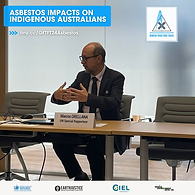
2023 UN Special Rapporteur Visit and Report
Dr. Marcos Orellana, the UN Special Rapporteur on Toxics and Human Rights, conducted his country visit to Australia in 2023. He interviewed Banjima Elder Maitland Parker about the contamination and ongoing harm at Wittenoom. Dr Orellana presented his report in July 2024, recommending that Australia take action to remediate environments contaminated by asbestos.

2025: YURLU | COUNTRY feature documentary released
Maitland Parker co-created award-winning feature documentary YURLU | COUNTRY with Illuminate Films during the final years of his life, up until his death from mesothelioma in 2024. The film intimately chronicles that period: Parker's declining health, advocacy, and efforts to heal and access his Yurlu (Country). It had its World Premiere at Sydney Film Festival.

Present: Banjima Native Title Aboriginal Corporation takes legal steps to remediate Wittenoom
After 60 years of inaction, Banjima Native Title Aboriginal Corporation is launching litigation for the remediation of Native Title Lands.
References
1 1994 Report of the Select Committee into Wittenoom p. 4
3 1992 Nevill Report into Asbestos issues at Wittenoom p. 32
4 1994 Report of the Select Committee into Wittenoom, p. 11
5 1994 Report of the Select Committee into Wittenoom, p. 11
6 1992 Nevill Report into asbestos issues at Wittenoom Appendix 1 p. 46
10 1992 Nevill Report into asbestos issues at Wittenoom Appendix 1 p. 48
11 1992 Nevill Report into asbestos issues at Wittenoom Appendix 1 p. 48
12 1992 Nevill Report into asbestos issues at Wittenoom Appendix 1 p. 48
14 1992 Nevill Report into asbestos issues at Wittenoom Appendix 1 p. 50
15 1992 Nevill Report into asbestos issues at Wittenoom p. 32
16 1994 Standing Committee on Constitutional Affairs and Statutes Revision in relation to A Petition Concerning the Town of Wittenoom, Chairman Hon M D Nixon p.6
25 1992 Nevill Report into asbestos issues at Wittenoom RECOMENDATIONS p. 42
29 1994 Report of the Select Committee into Wittenoom Chairman’s forward
30 2006 GHD/PB Non-technical Summary Report, Management of Asbestos Contamination in Wittenoom- commissioned by the WA Department of Industry and Resources & Department of Local Government and Regional Development p. 4-5
31 2006 GHD/PB Non-technical Summary Report, Management of Asbestos Contamination in Wittenoom- commissioned by the WA Department of Industry and Resources & Department of Local Government and Regional Development p. 8
39 2021 Contaminated Sites Act 2003 Basic Summary of Records Search Response ID 78799 2021 Basic_Summary_Of_Records_contamination outside the WAMMA78799
42 2023 Wittenoom Subcommittee Report: Data Gaps Assessment (Draft) p. 2
